Why We Procrastinate: 6 Reasons and How to Overcome Them

How to Stop Procrastinating and Get More Done in Business & Life
6 Reasons We Put Things Off - and How to Finally Get Them Done
Most business owners know exactly what it feels like to have something sitting on their to-do list for far too long. You know it needs to be done. You may even know it's important. But somehow, other tasks keep getting in the way. You answer a few emails. Check your messages. Tidy your workspace. Work on something easier. Suddenly the day is over and that one task is still sitting there waiting for tomorrow.
It's easy to assume procrastination is simply poor time management or a lack of discipline. But often, procrastination has less to do with how much time we have and more to do with how we feel about the task in front of us. Certain types of tasks naturally create more resistance than others. Understanding why you're avoiding something can make it much easier to figure out what to do about it.
1. The Task Is Boring
Some business tasks simply aren't interesting. Entering information into a spreadsheet. Organizing files. Updating records. Reviewing inventory. Filing receipts. Completing administrative paperwork. These tasks may be necessary, but they don't provide much stimulation. When something feels boring, our brains naturally look for something more interesting.
And today, finding something more interesting takes about two seconds. Your phone, email, social media, another project or even a different task on your to-do list can provide an immediate escape.
How to Overcome It
Make boring tasks smaller and more defined. Instead of telling yourself, "Today I need to organize all my business files," try: "I'm going to organize files for 20 minutes." A clear stopping point makes the task feel less overwhelming.
- Set a timer for 15-30 minutes
- Listen to music or a podcast while you work
- Group similar repetitive tasks together
- Give yourself a small reward when you're finished
- Schedule boring tasks during a time when your energy is naturally higher
You don't necessarily need to make the task exciting. You just need to make starting it easier.

2. The Task Is Frustrating
1. Identify Your Integral Tasks
Frustrating tasks create a different kind of resistance. Maybe the software isn't working properly. Maybe you've tried to solve the problem three times already. Maybe you're waiting for information from someone else. Or maybe you simply don't know why something isn't working.
Business owners encounter these situations constantly. The problem is that once we associate a task with frustration, we often begin avoiding it before we've even started.
How to Overcome It
First, identify exactly what is frustrating you. Instead of thinking, "I hate doing this," ask: "What specifically is making this difficult right now?" Maybe you need information. Maybe you need help. Maybe you're using the wrong tool. Maybe you need to learn something before continuing. Or maybe you've been trying to solve a problem yourself that would take someone with the right expertise 15 minutes to fix.
Once you identify the source of the frustration, you can work on removing the obstacle rather than continuing to avoid the entire task.

3. The Task Is Difficult
Difficult tasks require more mental energy. Creating a business plan. Analyzing your finances. Learning new software. Building a marketing strategy. Making an important hiring decision. Preparing a major proposal. When something requires significant concentration, it can be tempting to choose easier tasks instead.
This creates one of the biggest productivity traps in business: being busy without actually working on the things that matter most. You can spend an entire day completing small tasks and still avoid the one difficult task capable of moving your business forward.
How to Overcome It
Break difficult work into the smallest possible next step.
- Don't write: "Create marketing strategy." Write: "List my three ideal customer types."
- Instead of: "Redo website." Start with: "Rewrite homepage headline."
- Instead of: "Review business finances." Start with: "Open last month's profit and loss statement."
The first step should feel almost ridiculously easy. Because once you've started, continuing is usually easier. It can also help to schedule difficult work during your best concentration hours rather than leaving it until the end of the day when your mental energy is already depleted.

4. The Task Is Unstructured or Ambiguous
This may be one of the most overlooked causes of procrastination. Sometimes we procrastinate because we don't actually know what we're supposed to do. Consider a task like: "Grow the business."
Where do you start? Improve your website? Run advertisements? Call previous customers? Post on social media? Create a referral program? Network? Write a blog?
There are so many possibilities that the task becomes difficult to act on. And when your brain doesn't see a clear starting point, postponing the task becomes very easy. Ambiguity creates friction.
How to Overcome It
Turn vague goals into specific actions.
- Instead of: "Get more customers." Try: "This week I will contact five potential clients."
- Instead of: "Work on marketing." Try: "Create three social media posts and schedule them."
- Instead of: "Get finances organized." Try: "Gather all bank and credit card statements from last month."
A good test is simple: Could someone else look at this task and immediately understand what needs to be done? If not, it probably needs to be broken down further. Clarity creates action.

5. The Task Lacks Personal Meaning
We are much more motivated when we understand why something matters. Unfortunately, many everyday business tasks feel disconnected from the bigger goal. Updating a spreadsheet doesn't feel like growing your business. Following up with customers doesn't feel like building financial freedom. Reviewing expenses doesn't feel like creating the life you wanted when you started your company. But those connections exist. We simply don't always see them in the moment.
How to Overcome It
Connect the task to something bigger. Ask yourself: "Why does completing this actually matter?"
Maybe keeping your finances organized means making better decisions. Maybe following up with customers means building stronger relationships. Maybe creating systems means eventually having more time away from your business. Maybe completing your marketing plan means creating a more predictable stream of customers. Maybe reviewing your numbers means knowing whether you can afford your next hire.
The task itself may not feel meaningful. The outcome can be. When you reconnect everyday work to the reason you're building the business in the first place, motivation often becomes easier to find.

6. The Task Lacks Intrinsic Reward
Some work simply isn't fun. There's no immediate payoff. No excitement. No visible progress. And sometimes no one even notices that you did it. This is particularly difficult with tasks where the benefit comes much later.
Keeping accurate financial records doesn't provide instant gratification. Building systems doesn't immediately transform your business. Writing consistent content doesn't necessarily bring customers tomorrow. But these activities compound over time.
How to Overcome It
When the task itself isn't rewarding, create your own reward system.
- Track completed tasks visually
- Use a checklist and enjoy physically checking things off
- Work in focused 30-minute blocks
- Pair an unpleasant task with something enjoyable
- Give yourself a small reward after completing an important milestone
- Track your consistency rather than immediate results
Most importantly, learn to recognize progress even when the reward hasn't arrived yet. A lot of successful business-building work isn't exciting. It's consistent.
Consistency often produces results long after the individual task is finished.

Stop Asking "Why Am I So Unmotivated?"
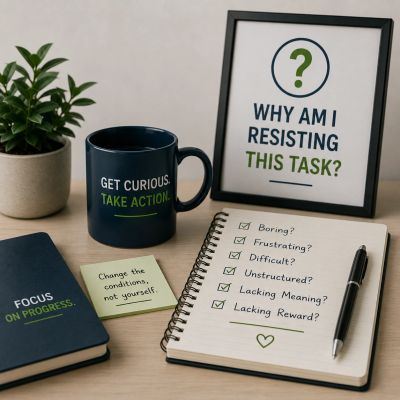
The next time you notice yourself procrastinating, don't immediately assume you need more discipline. Instead, get curious. Ask yourself: Why am I resisting this particular task?
Is it boring, frustrating, difficult, unstructured or ambiguous, lacking personal meaning, or lacking an intrinsic reward? Your answer tells you something important. Different types of procrastination require different solutions.
If it's boring, make it shorter or more enjoyable. If it's frustrating, identify and remove the obstacle. If it's difficult, break it into smaller steps. If it's ambiguous, define exactly what "done" looks like. If it lacks meaning, reconnect it to your larger goal. If there's no immediate reward, create one or focus on the long-term payoff.
Instead of trying to force yourself through resistance, change the conditions that are creating the resistance.
A Simple Procrastination Reset
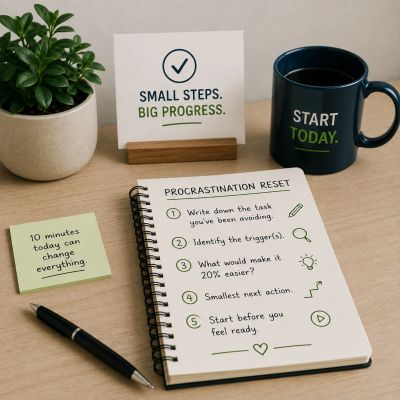
Step 1: Write down the task you've been avoiding. Be specific.
Step 2: Identify which of the six procrastination triggers applies. There may be more than one.
Step 3: Ask what would make the task 20% easier. Not perfect. Not effortless. Just easier.
Step 4: Identify the smallest next action. Something you could realistically complete in 10-20 minutes.
Step 5: Start before you feel ready. Motivation often follows action rather than coming before it.
Ten focused minutes on an important task can be more valuable than an hour spent avoiding it.
Sometimes the Best Solution Is Delegation
There is one more question every business owner should ask: "Do I actually need to be the person doing this?" Not every task deserves your time. As your business grows, part of becoming more productive is recognizing where your time creates the greatest value.
Some responsibilities need your expertise, creativity and decision-making. Others simply need to be completed accurately and consistently. If you repeatedly procrastinate on the same administrative task, it may be worth asking whether you need a better system, better training, better tools - or someone else to handle it.
Delegation isn't avoiding responsibility. It's deciding where your time is most valuable.