Productivity Reset: Master Your Time, Focus & Energy

PRODUCTIVITY BLUEPRINT: WORK SMARTER, FOCUS Better & GET MORE DONE!
Productivity isn’t about cramming as much work as possible into every hour of the day. True productivity is about doing the right work, with greater focus and efficiency, while protecting your time and energy. You can have an incredibly busy day and still accomplish very little that actually moves your business or life forward. Meetings, emails, notifications, small administrative tasks and constant interruptions can easily fill eight hours without producing eight hours of meaningful progress. Productivity changes when you stop asking, “How can I get more done?” and start asking, “What is the most important thing for me to get done?”
When you learn to identify your highest-value work, manage your time intentionally and protect your attention, productivity becomes less about working harder and more about creating better results.
What Is Productivity?
Productivity is the ability to turn your time, attention and energy into meaningful results. It combines several important skills:
- Identifying the work that matters most
- Prioritizing effectively
- Managing your time
- Maintaining focus
- Avoiding unnecessary distractions
- Taking action instead of procrastinating
- Creating efficient systems
- Managing your physical and mental energy
Productivity isn’t simply measured by how many tasks you check off. Completing ten insignificant tasks isn't necessarily more productive than completing one task that creates a major result.
For a business owner, that might mean spending two focused hours developing a new service, following up with potential clients or improving an important system instead of spending the entire afternoon reorganizing files. The value of the result matters just as much as the volume of work completed.

The Core Components of Productivity
1. Identify Your Integral Tasks
One of the most important productivity skills is learning to recognize your integral tasks - the activities that contribute most directly to your goals. Every day contains dozens of possible things you could work on. But only a small percentage of those tasks will create significant progress.
Your integral tasks might include:
- Revenue-generating activities
- Client acquisition
- Following up with leads
- Developing new products or services
- Improving important business systems
- Strategic planning
- Creating valuable content
- Building professional relationships
- Completing important client work
- Solving problems that are limiting growth
Start asking yourself: If I could only accomplish three things today, which three would have the greatest impact? Those tasks deserve your best time, energy and attention.
Action Step: At the beginning of each day, identify your Top 3 Priority Tasks. Complete at least one of them before allowing smaller tasks to take over your schedule.

2. Work on Important Tasks More Efficiently
Once you've identified your highest-value work, the next step is improving how efficiently you complete it. Many tasks take longer than necessary because we constantly switch between activities. You start writing something. Then you check an email. Then you respond to a notification. Then you remember another task. Then you return to what you were doing and have to mentally reconnect with the work. Every switch costs attention.
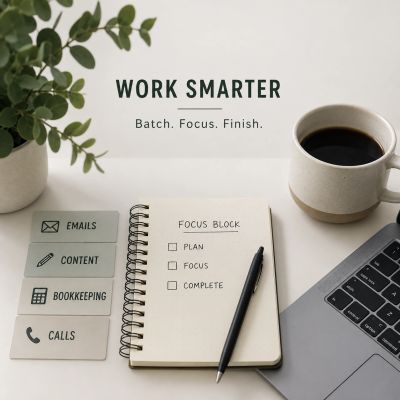
Instead, try batching similar activities together:
- Answer emails twice a day instead of continuously
- Create several social media posts at once
- Process bookkeeping transactions in one block
- Schedule administrative tasks together
- Make several phone calls consecutively
You spend less time mentally shifting gears and more time completing work.
Action Step: Choose 2–3 types of tasks you regularly repeat and group each type into a dedicated time block instead of handling them throughout the day.
3. Manage Your Time Like a Ninja
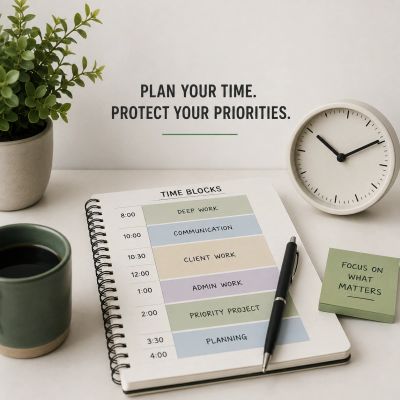
Everyone receives the same 24 hours. The difference often comes down to how intentionally those hours are used. Instead of working from a giant task list throughout the day, give important activities a specific place in your schedule. This is known as time blocking.
A workday might include:
- 8:00–10:00 — Deep work: Important projects, planning or creative work
- 10:00–10:30 — Communication: Emails, messages and follow-ups
- 10:30–12:00 — Client work
- 1:00–2:00 — Administrative work
- 2:00–3:30 — Priority project
- 3:30–4:00 — Planning and communication
Your schedule doesn't need to look exactly like this. The important principle is simple: Give your priorities time before everything else claims it.
Action Step: Before starting tomorrow, block specific periods of time for your three most important tasks. Don't simply write them on your to-do list. Decide when you will do them.
4. Quit Procrastinating
Procrastination rarely means that someone is lazy. More often, we procrastinate because a task feels too large, too complicated, unclear, boring, uncomfortable, overwhelming or difficult to start.
One of the simplest ways to overcome procrastination is to make the first step ridiculously small.
Don't tell yourself, “I need to finish the entire project.” Tell yourself, “I'm going to work on this for 10 minutes.” Starting reduces resistance. Once you've begun, continuing is usually much easier.
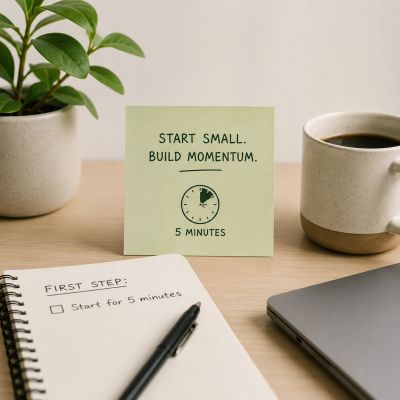
Use the 5-Minute Rule: When you're avoiding something, commit to working on it for only five minutes. Open the document. Write the first paragraph. Make the first phone call. Enter the first transaction. Organize the first file. Momentum often follows action.
Action Step: Choose one task you’ve been putting off and commit to working on it for just five minutes. Make the first step as small as possible and focus only on getting started. The goal isn’t to finish everything - it’s to create momentum.
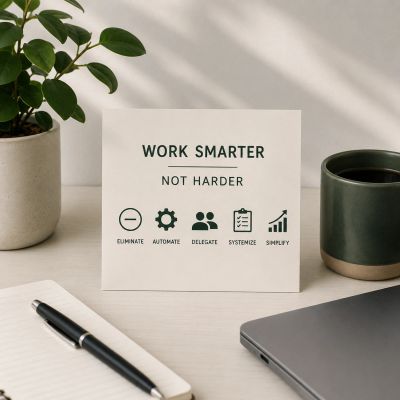
5. Work Smarter, Not Harder
Working longer does not automatically produce better results. Sometimes working smarter means asking: Does this task even need to be done?
Before spending significant time on something, consider whether you can:
- Eliminate it — Does it provide enough value to justify doing?
- Automate it — Can software or technology handle part of the process?
- Delegate it — Does this actually require your personal expertise?
- Systemize it — Could you create a repeatable process instead of figuring it out from scratch every time?
- Simplify it — Is there a faster or easier way to reach the same result?
- The goal isn't to become better at doing unnecessary work. The goal is to remove unnecessary work altogether.
Action Step: Choose one task you do regularly and run it through this filter: eliminate, automate, delegate, systemize or simplify. Identify one way to reduce the time or effort it takes before you do it again.
6. Develop Laser-Like Focus
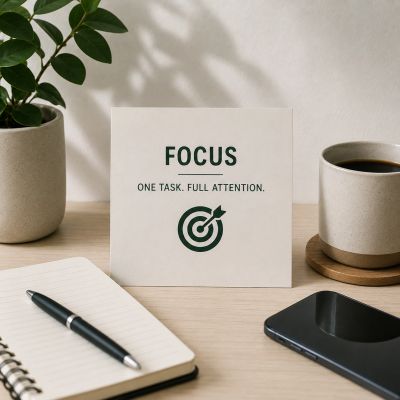
Focus has become one of the most valuable productivity skills. Modern life constantly competes for your attention through emails, social media, text messages, notifications, phone calls, news, meetings and apps. Every interruption breaks concentration. For important work, create periods of distraction-free focus.
Try working in 45–90 minute blocks where you:
- Put your phone away
- Silence notifications
- Close unnecessary browser tabs
- Avoid checking email
- Work on one clearly defined task
Then take a short break before beginning another focused session. A few hours of genuine concentration can often accomplish more than an entire distracted workday.
Action Step: Schedule one uninterrupted 60-minute focus block tomorrow. Choose one important task, remove every unnecessary distraction and work only on that task until the hour is finished.
7. Create Mental Clarity
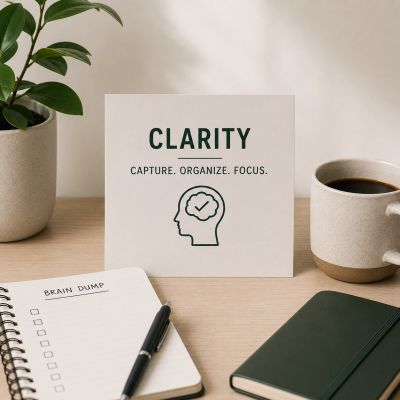
Productivity becomes much harder when your brain is trying to remember dozens of unfinished tasks.
Instead of using your brain as a storage system, create a reliable place to capture everything. This could be a digital task manager, your calendar, Apple Notes, a notebook or a project management system.
Once something is recorded somewhere you trust, your brain no longer has to keep reminding you about it. That creates something incredibly valuable: mental space.
Action Step: Set aside 10 minutes today for a complete brain dump. Write down everything competing for your attention, then sort each item into Do, Delegate, Schedule or Delete so your mind no longer has to hold onto it.
8. Protect Your Energy
Time management gets a lot of attention, but productivity also depends heavily on energy management. One highly focused hour when you're energized can be far more productive than three exhausted hours at the end of the day.
Pay attention to when you naturally perform your best work. If you're sharpest in the morning, don't automatically give those hours to emails and administrative work. Protect them for activities requiring creativity, strategic thinking, decision-making, writing and problem-solving.
Use lower-energy periods for simpler activities. Your physical habits matter too.
- Adequate sleep
- Movement
- Regular breaks
- Hydration
- Nutritious food
- Fresh air
- Time away from screens
You cannot continually demand peak performance from a depleted system.
Action Step: Identify the time of day when your energy and focus are naturally highest, then protect that window for your most important work. Save simpler tasks for lower-energy periods and support your productivity with proper rest, movement, hydration and regular breaks.

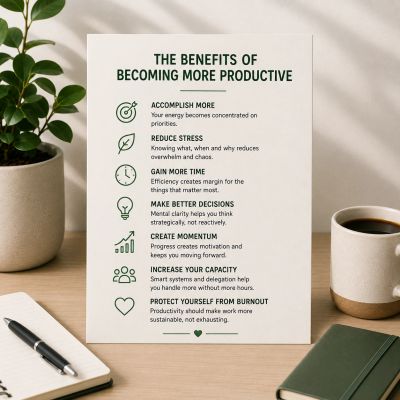
The Benefits of Becoming More Productive
- You Accomplish More Meaningful Work: Your energy becomes concentrated on priorities rather than scattered across dozens of small activities.
- You Reduce Stress: Knowing exactly what needs to be done and when you’re going to do it eliminates much of the chaos created by constantly reacting.
- You Gain More Time: Efficiency creates margin. That extra time can be invested into your business, family, hobbies, health or simply having more space in your life.
- You Make Better Decisions: Mental clarity allows you to think strategically instead of constantly operating in reaction mode.
- You Create Momentum: Progress creates motivation. Completing meaningful work makes it easier to continue moving forward.
- You Increase Your Capacity: Systems, delegation and efficient work habits allow you to handle more without simply adding more hours.
- You Protect Yourself From Burnout: Productivity should make work more sustainable—not turn every available minute into another opportunity to work.
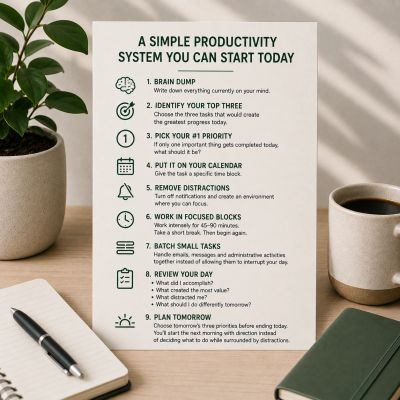
A Simple Productivity System You Can Start Today
- Step 1 — Brain Dump: Write down everything currently on your mind.
- Step 2 — Identify Your Top Three: Choose the three tasks that would create the greatest progress today.
- Step 3 — Pick Your #1 Priority : Ask: If only one important thing gets completed today, what should it be?
- Step 4 — Put It on Your Calendar : Give the task a specific time block.
- Step 5 — Remove Distractions: Turn off notifications and create an environment where you can focus.
- Step 6 — Work in Focused Blocks: Work intensely for 45–90 minutes. Take a short break. Then begin again.
- Step 7 — Batch Small Tasks: Handle emails, messages and administrative activities together instead of allowing them to interrupt your entire day.
- Step 8 — Review Your Day: Ask what you accomplished, what created the most value, what distracted you and what you should do differently tomorrow.
- Step 9 — Plan Tomorrow: Choose tomorrow’s three priorities before ending today so you can start the next morning with direction instead of deciding what to do while surrounded by distractions.
The Productivity Filter
1. Does this actually need to be done? If not, eliminate it.
2. Does it need to be done by me? If not, delegate it.
3. Can it be automated? Use technology when appropriate.
4. Can it be simplified? Look for unnecessary steps.
5. Is this more important than what I’m currently working on? If not, don’t allow it to interrupt your priority.
These questions help separate productive work from busy work.
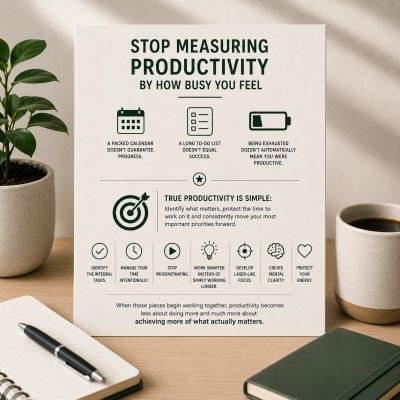
Stop Measuring Productivity by How Busy You Feel
Being exhausted at the end of the day doesn't automatically mean you were productive. A packed calendar doesn't guarantee progress. A long to-do list doesn't equal success. True productivity is much simpler. It's identifying what matters, protecting the time to work on it and consistently moving your most important priorities forward.
The goal isn't to squeeze more activity into your life. It's to become intentional about where your time, attention and energy go. Identify the integral tasks. Work on them efficiently. Manage your time intentionally. Stop procrastinating. Work smarter instead of simply working longer. Develop laser-like focus. Create mental clarity. Protect your energy.
When those pieces begin working together, productivity becomes less about doing more and much more about achieving more of what actually matters.