How Much Time Is Your Bookkeeping Costing You?

The hidden cost of doing your own books
When business owners think about the cost of bookkeeping, they usually think about one thing: how much they would have to pay someone else to do it. But there is another cost that is easy to overlook: the value of your own time. If you are spending several hours every month entering transactions, matching receipts, reconciling accounts, fixing errors, preparing reports and trying to figure out QuickBooks, your bookkeeping isn't actually free just because you're doing it yourself.
Your time has value. And once you calculate what those bookkeeping hours are really costing you, outsourcing may look very different.
Start With a Simple Calculation
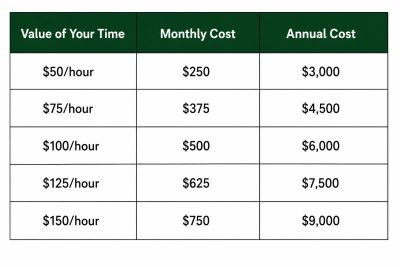
Think about how much time you spend on bookkeeping in an average month. For this example, let's use 5 hours per month.
5 hours × $50 = $250 per month
5 hours × $100 = $500 per month
5 hours × $150 = $750 per month
Over an entire year, those five hours per month add up to 60 hours. Suddenly, “I'll just do the bookkeeping myself” doesn't necessarily look free.
What Is an Hour of Your Time Really Worth?
Many business owners underestimate the value of their time because they think about it like an employee's hourly wage. Instead, consider what you can accomplish during an hour spent working on the parts of the business that generate revenue or create growth.
· Meet with a potential client
· Complete billable work
· Follow up on outstanding quotes
· Make sales calls
· Develop a new product or service
· Improve your marketing
· Build customer relationships
· Train or manage your team
· Work on the strategy of your business
If an hour spent on those activities could eventually generate $100, $200 or $500 in additional business, spending that same hour sorting receipts deserves a second look.

Try It With Your Own Numbers
Take a minute and calculate your own bookkeeping cost.
Step 1: How many hours do you spend on bookkeeping each month? _____ hours
Step 2: What is one hour of your time worth? $_____ per hour
Step 3: Multiply the two numbers. _____ hours × $_____ = $_____ per month
Now multiply that number by 12. $_____ × 12 = $_____ per year
That is the approximate value of the time you're currently putting into your bookkeeping each year. And five hours a month may actually be a conservative estimate.

Don't Forget the “Figuring It Out” Hours
Bookkeeping time isn't always obvious. You might only spend two hours actually entering or categorizing transactions, but what about the extra time spent:
· Searching for missing receipts
· Trying to understand why the bank won't reconcile
· Researching how to categorize an expense
· Correcting duplicate transactions
· Matching bank-feed transactions
· Looking up QuickBooks instructions
· Trying to understand GST
· Tracking down unpaid invoices
· Fixing transactions that were entered incorrectly
· Getting everything organized before year-end
Ten minutes here and twenty minutes there can turn into several additional hours every month. This is especially common when bookkeeping isn't something you do every day. A task that takes an experienced bookkeeper a few minutes may take considerably longer when you first have to figure out how to do it.

There Is Also an Opportunity Cost
The financial cost is only part of the equation. There is also opportunity cost—what you could have been doing instead. Imagine a business owner spends five hours every month doing bookkeeping. That's 60 hours per year. What could 60 hours focused on business development accomplish?
If you dedicated those hours to following up with potential customers, improving your services, creating marketing campaigns or building relationships, could that generate one additional customer? Five? Ten?
That's why the question isn't simply: “Can I do my own bookkeeping?”
Many business owners absolutely can. A better question may be: “Is bookkeeping the best use of my time?”

DIY Bookkeeping Can Make Sense
Outsourcing isn't automatically the right answer for every business. If your business is small, you have relatively few transactions, you understand bookkeeping and you have a good system in place, managing your own books may be perfectly reasonable.
The important thing is to make that decision intentionally. If bookkeeping takes one organized hour per month and you enjoy doing it, there may be little reason to change. But if you're losing an entire afternoon every month to receipts, reconciliations and QuickBooks—or constantly putting your books off because you don't have time—the calculation changes.

The Cost of Falling Behind
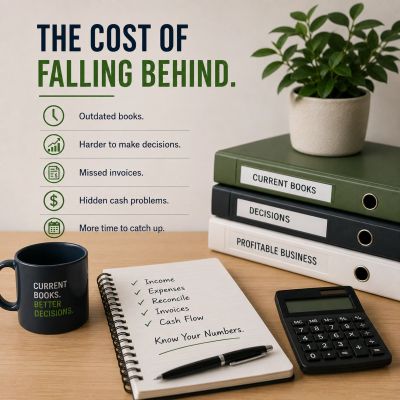
There is another hidden cost when business owners don't have enough time for bookkeeping: the books stop being current. When bookkeeping gets pushed to the bottom of the to-do list, transactions accumulate. Receipts disappear. Accounts aren't reconciled. Invoices may not get followed up on. Then instead of spending a manageable amount of time every month, you may eventually need to spend an entire weekend trying to catch up.
More importantly, outdated books make it harder to answer basic business questions:
· How much money did we actually make?
· Are expenses increasing?
· Who still owes us money?
· Do we have enough cash for upcoming expenses?
· Are we actually profitable?
Good bookkeeping isn't only about preparing information for tax time. It should provide financial information you can use throughout the year to make better business decisions.
Compare the Cost—Not Just the Price
When considering professional bookkeeping, don't simply compare $0 to do it myself vs. $X to hire a bookkeeper. Instead, compare the value of the time you're currently spending + the cost of mistakes + the cost of falling behind against the cost of having the bookkeeping professionally managed.
For example, if you spend five hours each month on bookkeeping and your time is worth $100 per hour, you're already investing approximately $500 worth of your time every month.
If professional bookkeeping gives you those five hours back, the question becomes: What could you do with them?

Your Time Should Be Spent Where It Creates the Most Value
As a business grows, the owner's role often has to change. In the beginning, you may do everything yourself because you have to. Eventually, growth requires deciding which responsibilities genuinely need your time and which ones can be delegated.
Your expertise, relationships, decisions and vision are difficult to replace. Entering transactions isn't.
The goal of outsourcing isn't simply to remove another task from your list. It's to give you more time to focus on the work that only you can do for your business.
Hours spent bookkeeping each month × value of your time = the real cost of DIY bookkeeping.
You may discover your bookkeeping is costing considerably more than you thought.